ImPLementation of an Advanced TelerehabIlitatioN solUtion for people with Multiple Sclerosis (PLATINUMS)
Jul 2024 – Jul 2027 (3 years)
 Ireland
 Israel
 Italy
 Denmark
Project Summary
Multiple sclerosis (MS) is one of the world's most common neurological disorders with a global prevalence
estimated at 2.8 million people. Exercise has been shown to significantly benefit people with multiple sclerosis (pwMS). It has been confirmed that exercise improves mobility, strength, and balance, as well as
reducing fatigue, depression, and anxiety, thus, improving the pwMSs well-being and quality of life. Unfortunately, although, the majority of pwMS are well aware of the significant advantages of exercise to
control the disease symptoms and maintain progression, many do not exercise at all. Moreover, the majorityof pwMS who do exercise find it difficult to persevere and stop after a relatively short period. There are several barriers that can account for why pwMS do not exercise regularly or stop exercising altogether.
Some are related with the disease symptoms (e.g. perceived fatigue, depression, mobility difficulties). Other significant barriers include lack of access to exercise/training facilities and health professionals in the field of physical rehabilitation and exercise training. Furthermore, transportation services can also be a barrier, particularly for those who live in rural areas, have mobility difficulties or are severely disabled. For pwMSwho require specialized transportation or who rely on public transportation, the logistics of getting to and from physical therapy/exercise facilities is complex, costly and time-consuming.
Telerehabilitation (telerehab)has great potential for providing accessible and cost-effective options for exercise therapy training for pwMS in the home environment. Only a few previous studies have demonstrated positive results when training with telerehabilitation, used to enhance physical activity in pwMS. Nevertheless, despite the advantages of this treatment strategy, there are still a number of limitations that prevent utilizing this technology on a large scale. The existing solutions are either too simplified, do not provide feedback when the patient does not correctly perform the exercise, or requires special hardware (e.g. movement sensors) often malfunctioning.
In the present project, we intend to implement a cutting-edge artificial intelligence (AI) technology for a home-based exercise therapy program for pwMS. The revolutionary telerehabilitation technology (https://www.wix.wizecare.com/) has been implemented in several healthcare services, mainly in the field of orthopedic rehabilitation, exhibiting encouraging results in conjunction with positive feedback from patients, physical therapists, and stakeholders. However, it has never been implemented in the MS population.
Therefore, our overall goal is to implement an innovative telerehabilitation exercise training program for pwMS through assessment of its efficacy on mobility, mood and social participation and to develop and validate new quality scores and remote clinical tests. To assess the efficacy, we propose a pragmatic multicenter randomized controlled trial in established MS centers across the EU community (Italy, Norway, Ireland, Denmark and Israel). Our secondary aims include: (1) designing, developing and testing a set of common mobility clinical tests delivered via the telerehabilitation system to be used for evaluating mobility difficulties in pwMS; (2) identifying the best strategies necessary to improve the implementation and increased use of telerehabilitation in pwMS through personal and group interviews with relevant stakeholders; and (3) examining the cost-effective value of the telerehabilitation exercise intervention program for pwMS at each site. Ultimately, knowledge gained from this research will not only be relevant for pwMS, it is expected to be of great value in understanding the most useful way to deliver and benefit from home-based exercise therapy in vulnerable populations including many healthy older adults and others withneurological impairment.
-
 03/11/2026
Patient Engagement in the PLATINUMS Project
A key highlight of the PLATINUMS project is our collaboration with Stefania Unida, an MS advocate fr...
-
 03/11/2026
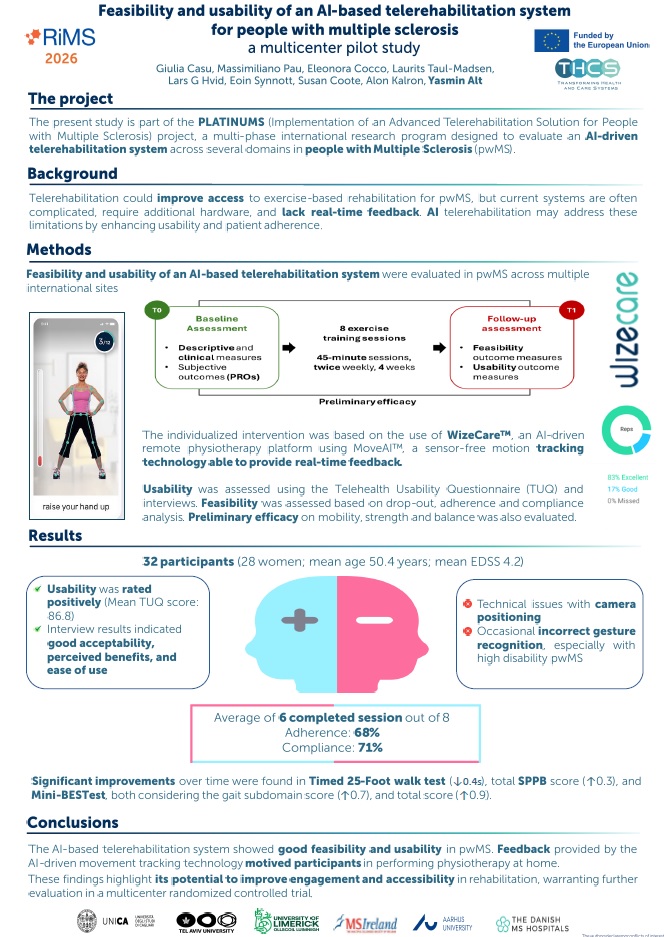
First results presented in RIMS congress (Prague, 2026)
Findings of the feasibility and usability of the AI-based telerehabilitation system have been succes...
-
 03/11/2026
An AI-Based Telerehabilitation Solution to Improve Mobility in People With Multiple Sclerosis (the PLATINUMS Project): Protocol for an Implementation and Evaluation Study
-
 03/11/2026
Protocol for a pilot effectiveness and feasibility randomized controlled trial of an advanced telerehabilitation system for people with multiple sclerosis (PLATINUMS project)
No activities linked to this project yet.
No solutions linked to this project yet.
Project Coordinator
-

Alon Kalron
Tel-Aviv University
Israel
Project Partners
-

Lars Hvid
Denmark
Danish Multiple Sclerosis Hospitals
-

Massimilano Pau
Italy
University of Cagliari
-

Susan Coote
Ireland
MS Ireland
-

Matt Herring
Ireland
University of Limerick